Country
Companies10 of 17
fourthline.com
Fourthline
fourthline.com🇳🇱 Netherlands
Fourthline is a Amsterdam-based identity verification and KYC infrastructure company built for the moment when compliance became fast. While traditional onboarding still takes weeks and swallows users in document checklists, Fourthline has engineered a streamlined verification engine that lets companies know who their customers are in seconds, not cycles. The platform combines biometric identity checks, document verification, and AML screening into a single API that developers can plug directly into their applications. This is infrastructure for fintech founders who want to launch regulated products without drowning in back-office friction. Fourthline works across Europe, handling everything from digital ID verification to sanctions screening, which means compliance teams get the certainty they need while customers skip the paperwork torture. The company occupies a crucial gap in the market: enterprises and fintechs need identity solutions that are both fast and bulletproof, and Fourthline has built exactly that. By treating KYC like a technical problem rather than a bureaucratic one, the company has positioned itself as the backbone for the next wave of fintech products that won't tolerate friction during signup.
Categories
Identity & KYC
mollie.com
Mollie
mollie.com🇳🇱 Netherlands
Mollie is a payment infrastructure company built for the internet age. Rather than forcing merchants through the byzantine setup process traditional payment processors demand, Mollie strips away the friction. You connect a few APIs, define your payment methods, and suddenly you're accepting everything from credit cards to local payment schemes across Europe—all without the operational headache of managing multiple provider relationships.
What sets Mollie apart is its uncompromising focus on developer experience. The company treats its payment platform the way SaaS companies treat their core products: with obsessive attention to documentation, dashboard clarity, and API elegance. Mollie handles the compliance complexity, the fraud monitoring, the settlement logistics. Merchants get a single pane of glass.
For a continent fragmented by payment preferences—iDEAL in the Netherlands, Bancontact in Belgium, SEPA everywhere—Mollie's multi-method approach feels essential rather than nice-to-have. The company works at the intersection of European e-commerce growth and the technical debt of legacy payment infrastructure, making it indispensable to thousands of online businesses that would rather build products than negotiate with acquiring banks.
Mollie has become something like the connective tissue of European payments: not as visible as the brands merchants serve, but embedded in the transaction flows of digital commerce across the continent.
Categories
Financial InfrastructurePayments
adyen.com
Adyen
adyen.com🇳🇱 Netherlands
Adyen is the global payments infrastructure that powers the world's biggest brands. Founded in Amsterdam and now operating across every major market, it's the connective tissue between retailers, their customers, and the financial system—processing everything from online checkouts to in-store transactions to marketplace payouts in a single, unified platform.
What sets Adyen apart is its refusal to operate as a traditional payments middleman. Instead of bolting together separate processors, gateways, and acquirers, it built its own infrastructure from the ground up, meaning faster settlement, lower friction, and genuine transparency on what you're actually paying. You see this philosophy everywhere: merchants get real-time visibility into their payments, developers integrate once and reach hundreds of payment methods, and the company has stayed agnostic to trends—it processes crypto as easily as it processes credit cards, embedded payments as easily as it processes commerce.
In a market crowded with legacy processors and upstart fintechs, Adyen occupies a unique position: it's genuinely global without being a sprawling conglomerate, technically sophisticated without being inaccessible, and profitable without relying on venture capital.
For enterprises serious about payments—whether they're selling fashion, booking flights, or managing marketplaces—Adyen represents the modern alternative to fragmented, outdated payment stacks.
Categories
Embedded FinanceFinancial InfrastructurePayments
degiro.eu
DEGIRO
degiro.eu🇳🇱 Netherlands
DEGIRO flipped the script on European retail investing by stripping away the middleman margins and making serious market access available to anyone with a browser. Instead of charging you £10 per trade like the traditional brokers, DEGIRO pioneered the subscription model for individual investors—pay a small monthly fee, trade stocks, ETFs, and derivatives at near-wholesale costs. What started as a Dutch insurgent in 2013 has evolved into a fully-fledged platform serving over two million Europeans who've grown tired of the gatekeeping.
The company doesn't dress itself up in gamification or hand-holding. DEGIRO is for people who want institutional-grade tools without the institutional price tag. You get real market data, direct access to multiple exchanges across Europe and beyond, and the ability to build actual portfolios rather than dabble in fractional shares. The platform speaks the language of serious retail traders and long-term investors alike.
Compared to the wave of neobanks obsessed with brand and lifestyle positioning, DEGIRO remains refreshingly utilitarian. It's not trying to be your friend or teach you to save. It's trying to democratize capital markets access—and it's done that better than almost anyone in Europe. In a landscape crowded with robo-advisors and savings apps, DEGIRO stands as proof that there's still an enormous appetite for pure, efficient market participation.
Categories
WealthCapital Markets
credolab.com
Credolab
credolab.com🇳🇱 Netherlands
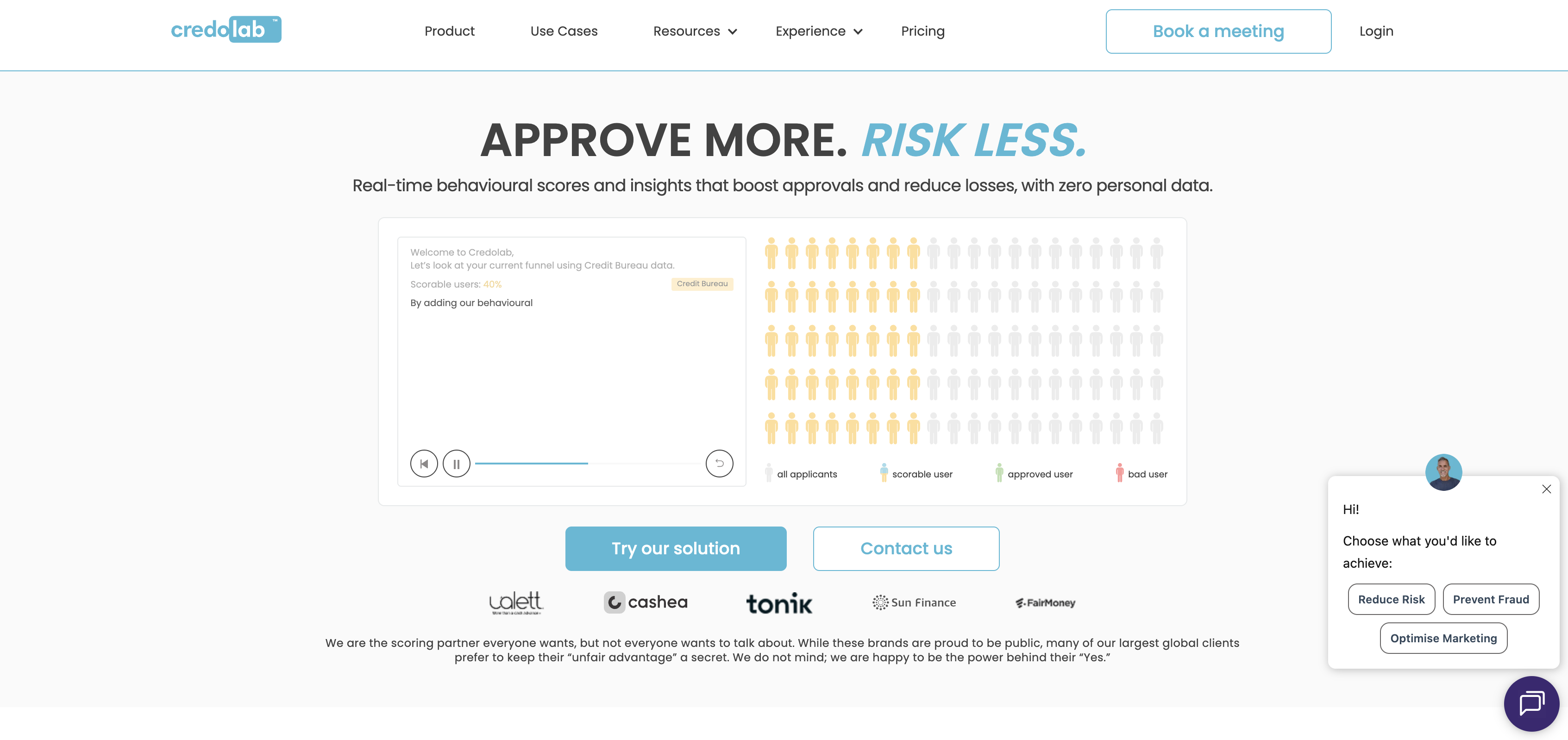
Credit decisions in markets without comprehensive credit bureau coverage have always been hard. The traditional underwriting model relies on credit history, income verification, and identity documents that significant portions of the global population either don't have or can't easily produce. Credolab was founded in 2016 with operations across Asia and Europe to address that gap with an unconventional data source — smartphone metadata. Its platform analyses behavioural patterns from a mobile device — without accessing personal content — to generate credit scores for consumers who have no traditional credit history. The data points are surprisingly predictive: how someone manages their phone storage, the pattern of their app usage, the regularity of their device behaviour all correlate with credit risk in ways that traditional underwriting misses. Credolab serves lenders, telcos, and digital platforms across emerging markets where credit bureau coverage is thin and the demand for digital credit is growing rapidly. In the alternative credit data landscape, where companies are competing to find the data sources that will define the next generation of underwriting, Credolab's behavioural smartphone approach is one of the more distinctive — and one that addresses a genuinely large unmet need in markets where billions of people remain credit-invisible to traditional financial systems.
Categories
Identity & KYCLending
pay.nl
Pay.nl
pay.nl🇳🇱 Netherlands
Pay.nl is a Dutch payment processor built for the complexity of modern commerce. Rather than forcing merchants into a one-size-fits-all payment flow, it offers a modular approach where acquirers, payment methods, and risk tools snap together like building blocks. This flexibility appeals to mid-market retailers and platform operators who've outgrown off-the-shelf solutions but don't have the resources to build from scratch.
The company positions itself as the pragmatic middle ground in European payments. While fintechs chase consumer flashiness and traditional PSPs move at legacy speed, Pay.nl focuses on the unglamorous reality of merchant operations: payment routing, multi-currency settlement, real-time reconciliation, and developer experience. Its API-first architecture means integrations take weeks instead of quarters.
Pay.nl operates across the full payment stack—card acquiring, alternative payment methods, tokenization, subscription billing—but treats them as components rather than marketing bullets. This modular thinking extends to risk management and compliance, which the company bundles without overhead.
Within Europe's crowded payments landscape, Pay.nl competes less on consumer reach and more on merchant control. It's the choice for companies that care about payment economics and operational efficiency rather than brand building. Its role in the broader ecosystem is to mature the middle market, proving that European merchants don't need either a tech giant's infrastructure or a startup's rough edges.
Categories
Financial InfrastructurePayments
in3.nl
in3
in3.nl🇳🇱 Netherlands
Buy now pay later arrived in the Netherlands with a specific local flavour. Dutch consumers have long been comfortable with deferred payment — the concept of paying in instalments is familiar from catalogue retail and traditional hire purchase — but the digital version needed to be built around Dutch payment infrastructure, Dutch consumer preferences, and the specific trust dynamics of the Dutch market. in3 was founded in the Netherlands in 2011 to offer exactly that. Its BNPL product lets consumers split purchases into three interest-free instalments, integrated directly into merchant checkouts across the Dutch e-commerce landscape. The three-instalment structure is simpler than the variable plans offered by some international BNPL providers, and the focus on zero interest differentiates it from products that monetise through consumer debt. in3 has built strong merchant acceptance across Dutch e-commerce and expanded into the broader Benelux market, positioning itself as the local alternative to Klarna and Afterpay in a market where local trust and local payment method integration genuinely matter. In the BNPL landscape, where the large international players are competing aggressively for European market share, in3's local depth is a real competitive asset.
icepay.com
ICEPAY
icepay.com🇳🇱 Netherlands
Dutch e-commerce has some of the highest online payment diversity in Europe — iDEAL for bank transfers, credit cards for international purchases, Afterpay for deferred payment, and a long tail of alternative methods that reflect the Netherlands' pragmatic approach to letting consumers pay however they prefer. ICEPAY was founded in the Netherlands in 2010 to help merchants navigate that complexity. Its payment gateway aggregates multiple payment methods behind a single integration, handling the technical and commercial relationships with payment providers so that merchants can focus on selling rather than managing payment infrastructure. The platform serves e-commerce businesses, digital services companies, and physical retailers across the Netherlands and broader European market. ICEPAY's positioning is straightforward — maximum payment method coverage with minimum integration effort — in a market where the range of payment preferences across European countries makes multi-method acceptance a genuine operational challenge. For merchants expanding from domestic to cross-border e-commerce, the payment method landscape is often the first obstacle they encounter and the last thing they want to spend engineering resources on.
Categories
Payments
billink.nl
Billink
billink.nl🇳🇱 Netherlands
Trust in e-commerce is asymmetric — consumers take a risk every time they pay before receiving goods, and merchants take a risk every time they ship before receiving payment. Billink was founded in the Netherlands in 2011 to resolve that asymmetry for the Dutch market with a pay-after-delivery service that lets consumers pay within 30 days of receiving their order. The model absorbs the credit risk on behalf of merchants, paying them immediately while extending the payment window to consumers — a structure that reduces cart abandonment and increases average order values in categories where consumers want to inspect before committing. Billink has built strong integration across Dutch e-commerce platforms and marketplaces, becoming a familiar payment option for Dutch online shoppers who value the security of paying after delivery. Its focus on the Dutch market — rather than the pan-European expansion pursued by larger BNPL players — has allowed it to build depth in local payment infrastructure, merchant relationships, and consumer trust that generalist competitors find difficult to match. In a BNPL landscape increasingly dominated by well-funded international players, Billink's local specialisation is both its constraint and its competitive moat.
multisafepay.com
MultiSafepay
multisafepay.com🇳🇱 Netherlands
The Netherlands has a payments culture that rewards local knowledge. iDEAL dominates online payments, Bancontact matters for Belgian customers, and the mix of methods that a Dutch e-commerce merchant needs to accept to avoid losing sales at checkout is specific enough that generic international processors often handle it clumsily. MultiSafepay was founded in Amsterdam in 1999 — ancient by fintech standards — and has spent two decades building deep integration with the Dutch and broader Benelux payment landscape. Its platform provides payment processing, fraud prevention, and payment method management for online merchants, with particular strength in the local payment methods that matter most to Dutch consumers. The company has expanded across Europe while maintaining its Benelux roots, serving thousands of merchants from independent retailers to enterprise e-commerce operations. In a payment processing market dominated by the global players, MultiSafepay's longevity and local depth represent a durable competitive position — the kind of trust and integration depth that takes decades to build and is difficult for a new entrant to replicate quickly.
Categories
Payments